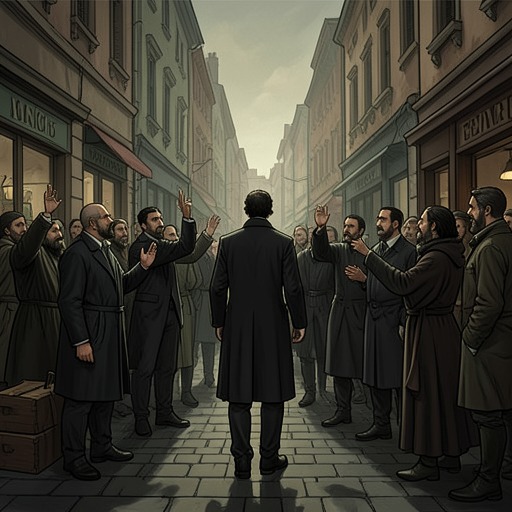
Rebus incapacitates Finlay Andrews
Hide and SeekJohn Rebus incapacitates Finlay Andrews by breaking through a mirror that conceals the room where Andrews has trapped him. In a club built around hidden observation and private games, Rebus turns the mirror from an instrument of surveillance into a breach: he reaches through it, seizes Andrews, and knocks him unconscious. The escape brings him back to the boxing hall, where Tracy is waiting.
The Club and the Search
The action follows John Rebus into the boxing club’s hall, where he calls Finlay Andrews’s name and surveys the chairs. The dried brown stains on the ring canvas make the building’s violence visible even when its audience is gone. But the hall is only part of what Rebus imagines: behind locked doors are guest bedrooms used for private games. He connects those rooms to the gatherings recorded in James Carew’s diary, held on the third Friday of the month, and to boys brought back from Calton Hill to serve the clients. His thought that Ronnie may have photographed the gatherings links the club’s sexual exploitation to the photographs that could threaten its participants.
Rebus’s reconstruction also supplies a motive for Ronnie’s death. Andrews had learned that Ronnie possessed insurance in the form of hidden photographs, though Rebus understands that the images may have been nearly useless as either blackmail material or evidence. Andrews did not need to know whether they could actually harm anyone; knowing they existed was enough. The brief conclusion that Ronnie had therefore died gives the confrontation a history of violence before Andrews appears in the room.
At the back of the hall, Rebus finds two doors in the shadows. He listens at each and hears nothing. Although he is sure someone is there, he has no audible confirmation; at the last moment, instinct makes him choose the right-hand door rather than the left. The pause and choice hold the scene between deduction and uncertainty. Rebus is following a suspicion into a space whose layout has been designed to conceal what happens inside it.
The Locked Room and the Mirror
Inside, Rebus switches on the delicate lamps beside the bed. The sparse room contains little beyond the bed and two large mirrors, one facing it and one above it. The door clicks shut behind him. Rebus deliberately shuts out his imagination and tells himself to stick to the facts: the bed and the mirrors. Then the door clicks again. He lunges for the handle, but it is locked tight.
His kick lands against the door without opening it, and the heel of his hired shoe breaks off. The failed attempt leaves him trapped and adds a practical cost to the danger: he remembers that the ruined shoe means losing his deposit on the dress hire. More importantly, the locked door changes his understanding of the room. If someone has locked him in, that person must be nearby; the adjoining room is the only other place to hide. Rebus turns to the mirror opposite the bed and calls Andrews’s name into it.
Andrews answers from the other side. Rebus can picture him standing behind the mirror, watching. He tests the situation by talking about people having sex in one room while others watch through a two-way mirror. Andrews corrects the idea that anyone watches for free: everything costs. Rebus then asks whether Andrews also set up the camera there. The exchange sharpens the room’s significance: the mirror is not simply a reflective surface but part of an arrangement in which private acts can be watched and recorded, and the watcher controls access.
Breaking Through
Rebus keeps Andrews talking, telling him that his fees are too high. The taunt buys time while he gathers his strength and thoughts, but the scene’s decisive move is physical, not verbal. He pulls back his arm, makes a fist, and drives it straight through the mirror. He applies a lesson from his SAS training: do not punch at an obstacle, but through it. Glass splinters around his arm and cuts into his jacket as his hand reaches the other side.
His fist opens into a claw and finds Andrews’s throat. Rebus clamps down and hauls him forward through the broken opening. Andrews shrieks as glass catches in his face and hair, enters his mouth, and pricks his eyes. Rebus holds him close, teeth gritted, then repeats that the fees are too high. The repeated taunt carries the earlier exchange into the attack: words that had served as a delaying tactic become the refrain accompanying the breach of Andrews’s hidden vantage point.
Rebus forms his other hand into a fist and strikes Andrews on the chin. He releases him, and Andrews falls back into the adjoining room unconscious. The action incapacitates Andrews without establishing any further outcome for him. Its immediate result is that Rebus can get out of the locked bedroom: he removes his useless shoe, taps away glass shards still clinging to the frame, hauls himself through the opening, and opens the door.
Aftermath and Significance
The scene ends not with an account of Andrews’s fate, but with Rebus back in the hall. He sees Tracy standing hesitantly in the middle of the boxing ring, her arms hanging at her sides, and addresses her by name. The return to the ring reconnects the bedroom’s concealed violence with the larger club, while Tracy’s presence gives Rebus’s escape an immediate human consequence. The action’s endpoint is therefore both practical and abrupt: Andrews is unconscious, the locked room has been breached, and Rebus has found Tracy.
The mirror concentrates the scene’s conflict in a single object. Rebus first treats it as evidence of the room’s watching system, then uses it as the only available route to the person controlling that system. The reversal does not erase the asymmetry of the hidden rooms: Rebus is trapped and watched before he can strike back, and the glass injures him as he crosses it. But the breach converts concealment into exposure. Andrews’s voice comes from behind the reflective surface; Rebus’s hand reaches through it and makes the unseen watcher physically vulnerable. The rescue of himself from the locked room, rather than any stated arrest or resolution, is the action’s concrete consequence.